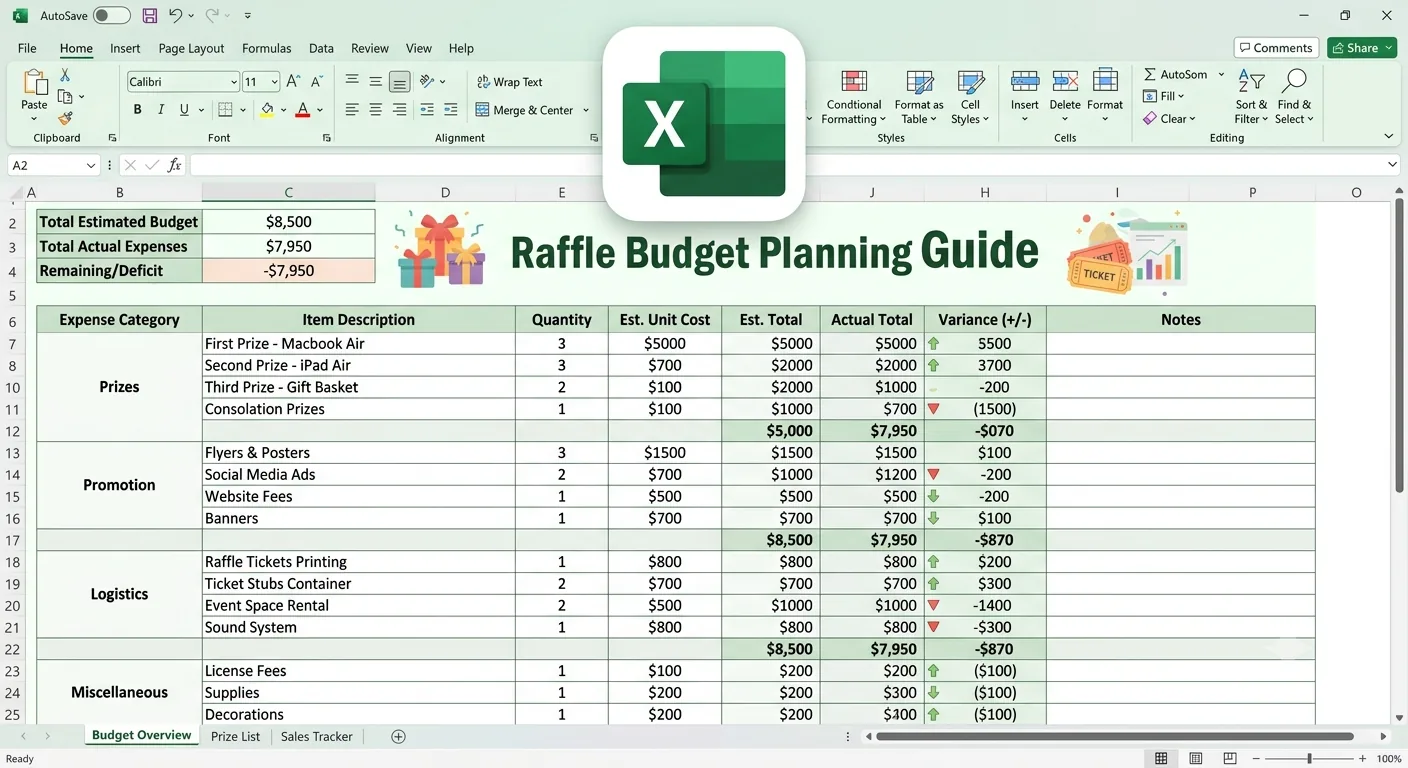
A raffle budget is a small document that answers a big question: will this raffle actually make money, and how much? Most raffles skip it, and most get away with skipping it, because raffles are forgiving. But the ones that disappoint, the campaign that raised $4,000 and cost $3,200, the "successful" raffle that consumed eighty volunteer hours for a few hundred dollars net, almost always disappointed at the planning stage, in a budget nobody wrote.
Here is how to build one in an evening, with a worked example to copy.
Start on the revenue side
Revenue is price times tickets sold, and the honest version of that equation starts with audience, not ambition. Estimate the people who will genuinely see your raffle: your email list, your event attendance, your social reach, your sellers' networks. Then apply a conversion you can defend; for a community organisation with a decent prize, converting 10–20% of a warm audience is solid, and a stretch assumption should still embarrass nobody.
Build three scenarios rather than one number:
- Conservative: the raffle underperforms; only your reliable core buys
- Target: your honest expectation
- Stretch: promotion lands, sellers deliver, the cap sells out
Your pricing and bundle structure drives the revenue per buyer in each scenario, and it deserves its own working; our ticket pricing guide covers the maths of price points and bundle design that this budget will inherit.
List every cost, including the invisible ones
Prizes. The line that decides your economics. Purchased prizes belong in the budget at full cost; donated prizes enter at zero, which is why our guide to getting raffle prizes donated is the highest-return hour of the whole project. If a sponsor underwrites costs in cash, budget it as negative cost rather than revenue, so your "raised for the cause" number stays clean; the underwriting model is idea three in our corporate sponsorship ideas.
Platform and payment costs. Digital raffle platforms charge in different ways: subscription, percentage, or per-ticket, plus card processing on each sale. Model them on your target scenario's volume so the comparison between options is honest.
Permits and licences. Permit fees range from nothing to meaningful depending on your jurisdiction and raffle size, and they are due before revenue exists. Our compliance checklist by country covers where to check.
Promotion and print. Often near zero for digital-first campaigns: signage, QR code printing, maybe a boosted post. Budget it anyway; unbudgeted small costs are how margins leak.
The float and the fiddly bits. Cash float for event sales, prize delivery or postage, thank-you gestures for volunteers. Small lines, real money.
The worked example
A school raffle, $5 tickets with a 3-for-$12 bundle, warm audience of about 1,200 families and event attendance of 400:
Three things this table teaches. The break-even is trivially low (a few hundred dollars of sales covers all costs), which is the structural reason raffles are low-risk fundraisers. The cost ratio falls as sales rise, because most costs are fixed; scale is nearly free. And the single line most worth attacking is the purchased prize: convert it to a donation and every scenario's net jumps $400 while the ratio drops several points.
Want this as a working spreadsheet? The three scenarios above are pre-built in our free budget planner, with live formulas: enter your own buyer numbers and costs, and net proceeds, cost ratio and break-even calculate automatically.
Download the free raffle budget planner (Excel)
Use the budget as a decision tool
The budget's job is not record-keeping; it is three decisions:
Go or no-go. If the conservative scenario barely clears costs, the raffle design needs work before launch: better prizes, a bigger audience, a different price, or a sponsor underwriting the costs.
Where effort goes. The scenario gaps show you what movement is worth. If stretch beats target by $1,800, the question becomes which levers close that gap, usually earlier launch, seller mobilisation and the countdown push, and whether they are worth the effort.
What the cap should be. For capped raffles, the budget sets it rationally: a cap your stretch scenario can actually approach creates real scarcity; a fantasy cap creates nothing.
Track actuals against it
After the draw, drop the real numbers into the same columns. The variances are next campaign's education: sales versus scenario tells you about your audience assumptions, average transaction versus budget grades your bundle design, and every cost line that surprised you gets a better estimate next time. This is fifteen minutes with your platform's Payments and Summary reports, and it folds directly into the baseline routine from our success metrics guide.
Keep the costs where you can see them
A digital raffle concentrates most of the cost side into visible, predictable lines, no ticket printing runs, no manual reconciliation hours, and the platform's reports produce your actuals automatically. Set up your raffle free on GalaBid's raffle platform, and let the budget you wrote in an evening run the campaign.